Silver, copper eclipse gold as top metals bets on supply fears
EU’s rare earths push is 10 years late, Boliden CEO says
Deep-sea mining damages animal life on seabed, study finds
Congo sets new export conditions to keep tight grip on cobalt
Mercuria JV to market half a million tons of Congo’s copper
Opinion: Awakening the Argentine giant
Silver, copper eclipse gold as top metals bets on supply fears
Silver and copper have replaced gold as the hot metal trade heading into 2026, with institutional and retail traders positioning for record rallies.
Silver has nearly doubled this year, with most gains occurring in the past two months due to a historic supply squeeze in the benchmark London market amid surging demand from India and silver-backed exchange-traded funds. While that crunch has eased in recent weeks as more metal is shipped to London vaults, other markets have seen supply constraints: Chinese inventories are at decade lows.
The silver rally has seen higher volatility, said Ed Meir, an analyst with Marex Group Inc. “If you look at the chart, there’s been a steeper parabolic move up than seen in previous rallies. The buying is much more concentrated, and in a much shorter time frame.”
Silver has outpaced gold of late. Since bullion hit a record on Oct. 20, it’s moved mostly sideways, while silver has gained more than 11% to a fresh record and copper has climbed almost 9%.
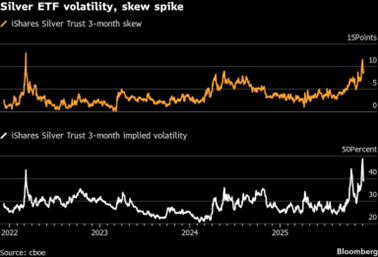
Implied options volatility in the iShares Silver Trust, the biggest ETF tracking the metal, rose last week to the highest since early 2021, when for a brief period silver attracted meme-stock traders. Almost $1 billion flowed into the ETF over the past week, exceeding the influx into the largest gold fund and adding further support to spot prices.
Western investors — who have been significantly under-allocated to precious metals — have flocked to silver ETFs in recent months, and there’s significant room for further inflows as allocation normalizes, said Trevor Yates, a senior investment analyst at Global X ETFs.
EU’s rare earths push is 10 years late, Boliden CEO says
The European Union should have taken action on rare earths 10 years ago, the boss of Swedish miner Boliden said on Friday, commenting on the European Commission’s plan to fast-track 3 billion euros ($3.5 billion) into 25 key mineral projects.
The importance of rare earth resources, powering everything from smartphones to electric vehicles, has been increasing as China, which produces more than 90% of the world’s processed rare earths, recently imposed additional export restrictions.
Europe’s lack of self-sufficiency in critical raw materials is a vulnerability that needs to be addressed, despite the slow process involved in making significant changes, Boliden CEO Mikael Staffas told Reuters.
He saw the EU executive’s latest initiative as a sign that the 27-country bloc wanted to do something, but warned a lot more needed to be done.
“The Critical Raw Materials Act that we got a while back was … a small step, and I think that EU will need to do many more small steps if they want to have some more independence,” Staffas said.
Aurubis CEO Toralf Haag said on Thursday that Europe’s largest copper producer had so far not seen much impact from the act, implemented last year, though he still expects it to have positive longer-term effects on the sector.
No projects under EU plan
Some minerals produced by Boliden, like copper and nickel, are on the EU’s key resources list. However, it sees little benefit from the new initiative, which focuses heavily on rare earths rather than other critical raw materials.
Deep-sea mining damages animal life on seabed, study finds
The largest study into the impact of deep sea mining has confirmed it causes a large amount of damage to animal life on the ocean floor.
Researchers found that the number of animals was reduced by nearly 40% in mined areas.
Deep-sea mining is a controversial process which involves testing untouched seabeds for important materials, including nickel, cobalt and copper.
These materials are used in things like rechargeable batteries to various types of technology.
The research was carried out by scientists at the Natural History Museum in London, the UK National Oceanography Centre and the University of Gothenburg, in Sweden, and was conducted at the request of deep-sea mining company The Metals Company.
The team spent more than five years studying how biodiversity could be affected by deep-sea mining.
They took a closer look at an area of the Pacific Ocean that has been targeted for mining.
The practice involves heavy machinery scooping up valuable mineral-rich deposits - from seabeds more than 200 metres deep.
The team compared biodiversity two years before and two months after the test mining that involved driving machines around 50 miles on the seafloor.
They looked specifically at tiny animals between 0.3mm – 2cm in size, such as worms, sea spiders, snails and clams.
They discovered that in the tracks of the vehicle, the number of animals fell by 37% and the diversity of species by 32%.
Eva Stewart, lead author of the study explained: "The machine removes about the top five centimetres of sediment. That's where most of the animals live.
"So obviously, if you're removing the sediment, you're removing the animals in it too."
However, in the areas near the vehicle tracks, where clouds of sediment landed, the abundance of animals did not decrease.
But some experts do not think that the results show any positive signs for mining companies.
Dr Patrick Schröder, from the Environment and Society Centre at think tank Chatham House, told BBC News: "These were only tests and the impact was significant.
"If they did that at large scale, it would be even more damaging," he added.
Congo sets new export conditions to keep tight grip on cobalt
Congo has set new conditions for cobalt exporters, according to a government circular reviewed by Reuters, potentially complicating a recently introduced quota system as the country seeks to keep a tight grip on the key battery mineral.
The new conditions require miners, among other things, to pre-pay a 10% royalty within 48 hours and secure a compliance certificate, the circular shows.
The Democratic Republic of Congo replaced a months-long export ban with a quota system in October, aiming to boost state revenues and tighten oversight in a country that produces more than 70% of the world’s cobalt, a key component in electric vehicle batteries.
No shipments have moved since the ban was lifted as producers seek clarity and work to meet compliance rules, Reuters has previously reported.
The joint circular from the mines and finance ministries, dated November 26, sets out procedures for exporters, including mandatory quota verification, joint sampling, weighing and sealing of lots, and issuance of a new Quota Verification Certificate (AVQ) by the Authority for the Regulation and Control of Strategic Mineral Substances’ Markets (ARECOMS).
The AVQ must accompany export documentation alongside a checklist of certificates from multiple agencies. The rules took effect immediately.
Exporters must also pre-pay a 10% mining royalty on allocated quotas within 48 hours of filing origin and sales declarations, and obtain a “liberatory receipt” before customs clearance.
All mineral shipments will undergo physical inspections and be subject to multi-agency oversight, the circular states.
The mines and finance ministries did not immediately respond to requests for comment, nor did Congo’s mines chamber.
Mercuria JV to market half a million tons of Congo’s copper
Mercuria Energy Trading has started a metals trading joint venture with Democratic Republic of Congo’s Gécamines SA to market copper and cobalt the country gets from equity stakes in local mines.
In addition to large amounts of cobalt, the joint venture could end up marketing over 500,000 tons of copper cathodes annually, Kostas Bintas, head of metals at Mercuria Energy Group Ltd., said in an interview on Friday.
The move was announced as part of US-brokered peace accord between Congo and its neighbor Rwanda. The US International Development Finance Corp. has also signed a letter of intent to discuss taking a financial stake in the joint venture which would see US end users get the right of first refusal on materials it sells.
And it comes as traders are scouring the market for copper to help meet supply dislocations born from US President Donald Trump’s tariffs as well as mining shortfalls. Copper prices on the London Metal Exchange are trading at their highest levels on record and traders have made fortunes shipping units to America for huge premiums to prices in the rest of the world.
Since hiring Bintas from rival firm Trafigura last year, Mercuria has become one of the fastest growing traders in metal markets.
Bintas said that Mercuria has already traded 1.2 million tons of copper cathodes globally this year and that the joint venture should mean it becomes the biggest exporter of copper cathodes out of Africa’s Copperbelt region in 2026. Mercuria also has a similar agreement with Zambia, Africa’s other big producer of the metal.
What place holds the highest probability for a new world-class discovery?
As an Australia-based geologist and investor, I tend to look in my own backyard first, which is the home bias effect. But the thing is, thanks to decades of a supportive mining environment, well-trained staff, and advanced exploration methods, the prospect of discovering another giant deposit in Australia is fading.
Don’t get me wrong, there could still be potential in remote outback locations, like the Tanami.
But compared to places like West Africa, where high-grade gold can still be found close to surface, Australia’s giant discovery potential is diminishing.
Then there’s Canada. Like Australia, Canada has been heavily explored thanks to its supportive governance and skilled labour force. It has also lost its discovery potential.
But like Australia, there are still some remote frontiers – especially in the far north – that hold discovery potential.
But if you want to stack the odds firmly in your favour and pick a place with the highest potential for a major discovery, look no further than Argentina.
Land of the giants
Argentina sits as one of the best places for explorers and their shareholders. And there are a few reasons why that’s the case.
To understand the potential here, you must look at its neighbour, Chile and what it has achieved in its mining industry over the last several decades.
Chile is the world’s largest copper-producing nation. That’s enabled it to remain one of the wealthiest nations in South America. Its economy feeds off its vast copper exports, thanks to discoveries made 30, sometimes 50 years ago. It holds mega-copper projects that have left a legacy of long-term production.
But across the border, Argentina’s copper output has gone from modest to virtually nil. So, is there less copper in Argentina or is something else happening here?