Behre Dolbear will be attending 121 Mining Investment in Cape Town, 9-10th February 2026.
We look forward to seeing those attending. If you would like to meet us please send a message to enquiry@dolbear.com or Linkedin.
Behre Dolbear will be attending Mining Indaba in Cape Town, 9-12th February 2026.
We look forward to seeing those attending. If you would like to meet us please send a message to enquiry@dolbear.com or Linkedin.
HEADLINES
US mineral supply chains remain exposed to China chokehold: USGS report
How Rio–Glencore talks fell apart
Midnight Sun rises on Zambia-DRC copper district where superpowers converge
Saudi graphite plant is ‘wake-up call’ for Quebec, France: CEO
Cornish Metals receives $225M funding interest from US EXIM
Ivanhoe in talks to send Congo zinc to US stockpile
US mineral supply chains remain exposed to China chokehold: USGS report
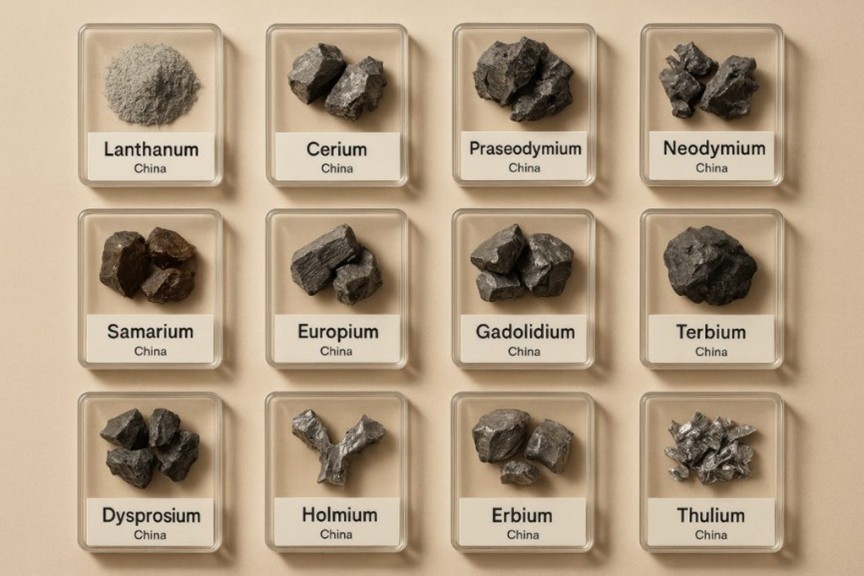
A display of various rare earth elements in labeled containers, showcasing their distinct forms and origins, primarily from China.
A new report by the US Geological Survey reveals that the United States has grown more reliant on foreign imports of minerals over the past year, highlighting the increased urgency to bolster its domestic supply chains.
In its annual mineral commodities summary published on Friday, the USGS found that the country was 100% import reliant last year for 16 out of the 90 non-fuel commodities that it tracked. In addition, the US relied more than one-half of its apparent consumption for 54 of the minerals, the report showed.
In comparison, the 2024 data showed 100% import reliance for 15 commodities and more than one-half import reliant for 46 minerals, the USGS said.
As highlighted in the report, the United States is totally reliant on its imports of arsenic (all forms), asbestos, cesium, fluorspar, gallium, graphite (natural), indium, manganese, mica (natural), niobium (columbium), rubidium, scandium, strontium, tantalum, titanium (sponge metal) and yttrium. Most of these are on the USGS critical minerals list, with asbestos, mica and strontium being the only absentees.
An additional 20 critical minerals had a net import reliance of greater than 50%, down from 28 in 2024, USGS noted.
Former Glencore (LON: GLEN) chief executive Ivan Glasenberg spent years pursuing one prize above all others: a merger between his firm and Rio Tinto (ASX, LON: RIO) that could have reshaped global mining.
That ambition died quickly this week, with the latest talks collapsing in less than 24 hours as Rio announced it would no longer pursue a merger or any other business combination. The miner concluded it could not strike a deal that didn’t deliver enough value for its shareholders.
Glencore’s response opened with who would be in charge, saying Rio wanted to retain both the chief executive and chair roles, before getting to what it considered the real issue, the Financial Review reported. The company said Rio’s proposed ownership structure “significantly undervalued Glencore’s underlying relative value contribution to the combined group,” even before any takeover premium.
Midnight Sun rises on Zambia-DRC copper district where superpowers converge
Canadian explorer Midnight Sun Mining (TSXV: MMA) just released an initial resource in the heart of the Zambian-Congo Copperbelt, an area that’s attracting Cold War-style financing competition to speed the record-price red metal to market.
The junior reported Jan. 20 that its Kazhiba deposit, a small part of its Solwezi project’s Dome Region shallow copper system, holds 2.33 million indicated tonnes grading 1.41% copper for contained copper of 72.4 million pounds.
It’s a tiny package so far, but it’s in the belt ranking second-largest in global copper output and reserves, trailing only Chile. First Quantum Minerals (TSX: FM) has the Kansanshi mine next door and Sentinel further away. Barrick Mining (TSX: ABX; NYSE: B) operates Lumwana to the west, and Ivanhoe Mines (TSX: IVN) partners with China’s Zijin Mining to run the Kamoa-Kakula complex north of the border in the Democratic Republic of Congo (DRC).
With spot copper prices rising to all-time highs – more than $6 a lb. before the early February sell off — Midnight Sun President and CEO Al Fabbro says the company’s timing is right to sell Kazhiba copper to pay for drilling on the more promising 20-km long Dumbwa deposit nearby.
“We secured absolutely critical ground at the heart of what is now emerging as one of the world’s premier copper districts, ground that today would be virtually impossible for anyone but a major to acquire,” Fabbro told The Northern Miner by email. “It’s ground now at the centre of a geopolitical tug-of-war between the US and China as they compete for access to this vital copper supply.”
Saudi graphite plant is ‘wake-up call’ for Quebec, France: CEO
Northern Graphite’s (TSXV: NGC) decision to build a $200 million battery material plant in Saudi Arabia should serve as a warning for governments in Canada and France, where the miner has been mulling similar projects, CEO Hugues Jacquemin says.
Ottawa-based Northern last month agreed with Saudi Arabian conglomerate Al Obeikan Group for Investment to jointly build and operate the facility after the miner restarts a dormant mine in Namibia. Construction is expected to begin in the second half after a final feasibility study has been completed, with production set for 2028.
Until announcing the Saudi commitment, North America’s only producer of natural graphite had been developing plans to build battery material facilities in Baie-Comeau, Quebec and France. Those two projects will now take a backseat to the Saudi venture, Jacquemin said.
“Certainly it’s a wake-up call for those two regions to come up with incentives that would allow us to move forward,” Jacquemin told The Northern Miner in an interview after announcing the Saudi Arabia venture.
“At the end of the day, it’s a question of resource and money. The graphite is there. It’s in the ground. If there is a will, there is a way.”
Power allocation
Northern has previously said operations in Baie-Comeau could start as soon as 2027. Capacity would initially be about 20,000 tonnes a year, with potential for expansion. Securing power from Hydro-Québec, the province’s electricity producer, will be crucial for the fate of the proposed plant.
Cornish Metals receives $225M funding interest from US EXIM
South Crofty tin project in the UK.
Cornish Metals (AIM: TIN) has been tapped by the US government for potential funding to support its plans to restart a British tin mine that has been sitting idle for decades.
On Thursday, the UK-based tin miner announced that the Export-Import Bank of the United States (EXIM) has expressed interest in providing as much as $225 million for the South Crofty tin project in Cornwall.
In the EXIM’s letter of interest, the credit agency said the funding would be conditional on the mine providing the US with “a responsible supply” of tin, which the government considers a critical mineral.
Tin is the ideal material for soldering in electronics, due to its resistance to corrosion and malleability. The metal plays an integral role in connecting semiconductor chips to circuit boards, and amid the surge in AI investments, its demand has surged in recent years.
Around two-thirds of the global tin supply comes from China, Myanmar and Indonesia, making countries like the US vulnerable to supply shocks.
Cornish Metals’ CEO Don Turvey says the LOI is a “testament to the quality and strategic importance of South Crofty” and its “potential to become the first new tin producer in the Western world.”
Reviving historic mine
The South Crofty mine had been producing tin for over four centuries, before a collapse in metal prices forced it to shut down in 1998. Several companies had been trying to revive the operation afterwards without success.
In 2016, Cornish Metals stepped in and has worked on the project since. According to the company, South Crofty represents the highest-grade tin deposit not currently in production. The proposed mine area hosts 2.9 million indicated tonnes grading 1.5% tin and 2.63 million inferred tonnes grading 1.42% tin. In addition, the company has also flagged a near-mine exploration target of 6 to 13 million tonnes grading 0.5% to 1.8% tin.
Ivanhoe in talks to send Congo zinc to US stockpile
Reopening of Kipushi mine.
Ivanhoe Mines (TSX: IVN) is in advanced talks with Congo’s state miner Gecamines and Swiss commodities trader Mercuria to route zinc-rich concentrate from its Kipushi mine to the United States under Washington’s newly launched strategic stockpiling scheme, Project Vault.
The discussions follow the White House launch of Project Vault, which Ivanhoe founder and co-executive chairman Robert Friedland attended. The $12 billion program aims to secure long-term supplies of strategic metals, backed by $1.67 billion in private capital and a $10 billion loan facility from the US Export-Import Bank.
Momentum behind the plan is building in Washington. Senators are set to introduce legislation on Wednesday to reauthorize funding for the Export-Import Bank for another decade, with the goal of injecting an additional $70 billion into the agency to support Trump’s critical minerals agenda, the Financial Times reported.
Republican senator Kevin Cramer of North Dakota, who is co-sponsoring the bill with Democrat Mark Warner, told the FT that Trump was “all in” on backing Ex-Im and “sees the value” of the institution. Cramer said he would push to raise the bank’s lending cap to $205 billion from $135 billion as part of the package.