Trump woos Venezuela with potential deals as relations reset
Gulf disruption squeezes Indonesia nickel makers’ sulphur supply
Aluminum price rises to 2022 high as Iran war stokes supply crunch
Deep-sea mining debate reaches critical global moment
Glencore to back Kazakh entrepreneur’s purchase of 40% stake in ERG, FT reports
There is still plenty of upside in the mining sector as bull market euphoria has yet to materialize, says Soar Financial CEO
Is copper back?
Red metal gaining in popularity
WHITE PINE — The potential of Michigan copper mining is returning to the spotlight after a 30-year absence, since the White Pine mine, in Ontonagon County, was closed.
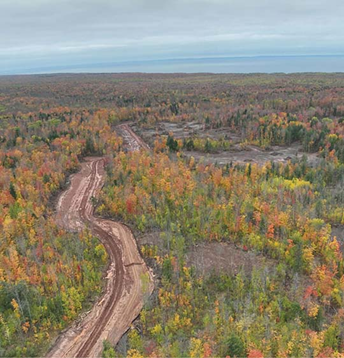
Site of Highland Copper Company’s Copperwood Mine Project, near Wakefield, in Gogebic County.
In a statement released Monday, Highland Copper Company announced it completed the sale of its 34% interest in the White Pine North Project to its joint venture partner, Kinterra Copper USA. Kinterra now has full control of White Pine North.
The Project represents the extension of the White Pine mine, which was developed and operated by the historic Copper Range Company from 1953 to 1995.
The proceeds from the White Pine sale, the Monday Highland release said, will be used to fund planned Copperwood Project activities, eliminate the existing debt to Kinterra, pay for the costs of the transaction and for general working capital.
Highland Copper is a Canadian company focused on exploring and developing copper projects in the Upper Peninsula, the company’s website says. The Company also owns surface rights securing access to the Copperwood deposit and providing space for infrastructure at Copperwood as required.
Kinterra Copper USA is an affiliate of private equity firm Kinterra Capital, also a Canadian company, which is actively developing U.S. copper assets to support the energy transition, controlling approximately 14 billion pounds of copper resources.
These statements coincide with a Feb. 2 announcement from the White House introducing Project Vault. Project Vault is a U.S. Strategic Critical Minerals Reserve, a public-private partnership funded by a $10 billion loan from the U.S. Export-Import Bank (EXIM) and nearly $2 billion in private sector capital–will be a physical minerals stockpile for civilian use. Project Vault establishes the U.S. Strategic Critical Minerals Reserve, an independently governed public-private partnership that will store essential raw materials in secure facilities across the United States.
Trump woos Venezuela with potential deals as relations reset
Interior Secretary Doug Burgum was still flying back from Venezuela when the Trump administration made it official: The US would re-establish diplomatic relations with the South American country, seven years after suspending operations at its embassy in Caracas.
The formal step marked the culmination of Burgum’s two-day mission in Venezuela to drive policy reforms and investment meant to unlock the country’s oil and mining riches — with the promise of simultaneously nurturing greater political stability and improving living conditions.
It’s a kind of dollar diplomacy — with President Donald Trump using the lure of foreign investments to nudge along democratic reforms, just two months after the US captured former President Nicolas Maduro.
Critics say Washington is attempting to vassalize Venezuela, taking control of its crude, coal and critical minerals for its own gain. But Burgum and other Trump officials see a chance to foster friendly supply chains for oil and minerals that can’t be easily choked off, while making Venezuela more stable to the benefit of both residents and neighboring nations.
“Venezuela’s leadership is leaning in hard toward building a positive, strong, enduring relationship with the United States,” Burgum said. “They’re creating a framework that is going to mean more peace, more stability, more prosperity for the people of Venezuela.”
Burgum left Caracas after securing a promise from interim President Delcy Rodriguez that the country would advance mining law reforms seen as essential to luring foreign investment. He also presided over the signing of agreements helping Shell Plc restart oil and gas development with Venezuelan and American contractors.
Gulf disruption squeezes Indonesia nickel makers’ sulphur supply
Large cargo ship in the port of the Gulf of Eilat
Nickel makers in Indonesia reliant on the Middle East for 75% of the sulphur they use may have to cut production as Gulf shipping is increasingly disrupted by the conflict in the region, analysts said.
Sulphur is used to make sulphuric acid, which is essential for leaching metals from ore in nickel refining and copper processing, with some copper producers in Africa potentially facing similar problems.
The Middle East accounted for around 24% of global sulphur production at 83.87 million metric tons last year, according to the US Geological Survey.
But disruption to shipping in the Strait of Hormuz, as a result of US and Israeli attacks on Iran and Tehran’s widening retaliation, is threatening to squeeze supplies.
Indonesia, home to more than 50% of global nickel production, imports roughly three quarters of its sulphur from the Middle East, according to Peter Harrisson, analyst at consultancy CRU. The country’s nickel is used mostly to make stainless steel.
Aluminum price rises to 2022 high as Iran war stokes supply crunch
Aluminum rose to the highest in almost four years as escalating hostilities in the Middle East worsened the supply outlook from the region, while copper and other industrial metals fell on falling risk appetite.
Aluminum rose as much has 1.6% to $3,499.50 a ton, the highest since April 2022, on the London Metal Exchange, following a gain of almost 10% last week as the war snarled shipments shipments from the Persian Gulf. The region accounts for about 9% of global supply, and traders are bracing for more disruptions.
Buyers of the metal in the US are rushing to secure alternative cargoes from Asia after at least two major smelters in the Middle East — one in Qatar and one in Bahrain — were forced to suspend deliveries.
Crude oil spiked about 20% on Monday as the war curbed more production, reflecting deepening worries around the duration of the war and its impact on the global economy. Broader financial markets tumbled on Monday as investors avoided risk assets.
Deep-sea mining debate reaches critical global moment
Ocean governance is entering a decisive moment as governments weigh whether to allow deep sea mining in international waters or impose a global moratorium while science and regulations catch up.
The debate is intensifying ahead of a key meeting of the International Seabed Authority (ISA), the UN-established body that manages mineral-related activities in the deep sea. Governments will gather in Kingston, Jamaica, from March 9 to 20 to continue negotiations on a proposed mining code that could open the door to commercial seabed mining.
Experts warn that decisions made in the coming months could determine whether the deep ocean remains protected as humanity’s shared heritage or becomes the next frontier of industrial extraction.
At a media and policy briefing Wednesday, Samantha Robb, a senior associate with Ocean Vision Legal, outlined the legal risks of mining outside the ISA system. She said the United Nations Convention on the Law of the Sea (UNCLOS) establishes the ISA as the sole authority to regulate mining in seabed areas beyond national jurisdiction, yet some companies and governments are exploring ways to proceed independently.
Robb pointed to recent developments in the US, where a new domestic regulatory pathway created by President Donald Trump could authorize mining in international waters. Such actions, she said, would conflict with UNCLOS provisions that designate the deep seabed and its resources as the “common heritage of humankind,” meaning activities must benefit all people, including future generations.
Unilateral mining, she warned, would bypass mechanisms designed to ensure equitable distribution of financial benefits and environmental protections. It could also destabilize international governance structures built on multilateral cooperation.
Glencore to back Kazakh entrepreneur’s purchase of 40% stake in ERG, FT reports
Glencore has proposed supporting Kazakh entrepreneur Shakhmurat Mutalip’s $1.4 billion bid to buy a 40% stake in miner Eurasian Resources Group, the Financial Times reported on Thursday, citing people familiar with the discussion.
ERG’s Frontier mine in DRC
The London-listed miner has proposed a $800 million upfront pre-payment in exchange for future shipments of ferrochrome, mainly used in steel production, to help finance the bid, the report added.
Glencore and Eurasian Resources Group did not immediately respond to a Reuters request for comment.
Mutalip’s bid is close to being finalized, having overtaken a rival bid from Shukhrat Ibragimov, the CEO of Eurasian Resources and son of the company’s co-founder Alijan Ibragimov, FT said.
Glencore had previously tried to buy the former FTSE 100 company in 2011 for 12 billion pounds ($15.99 billion), according to a media report at the time.
The London-listed miner and Mutalip are also in active discussions over his bid to acquire its 70% stake in another Kazakh miner, Kazzinc, FT added, which it said could be worth about $3.5 billion.
There is still plenty of upside in the mining sector as bull market euphoria has yet to materialize, says Soar Financial CEO
(Kitco News) - After more than a decade of lackluster price action, the mining sector has started to see some significant momentum, and if sentiment at this year’s Prospectors & Developers Association of Canada (PDAC) 2026 Conference is any indication, the new bull market cycle for miners is just getting started.
In the last 12 months, VanEck Gold Miners ETF (NYSE: GDX) has rallied more than 160%, currently trading at $106.22. After years of underperformance, the precious metals equities have significantly outperformed the gold market, which has rallied 98%, currently trading at $5,125.80 an ounce.
While the mining sector is attracting new capital, Soar Financial CEO Kai Hoffmann said in an interview with Kitco News that the market still has plenty of upside potential as it lacks the euphoric sentiment that traditionally signals market peaks.
Although the world’s largest mining ETF is near record highs, Hoffmann said that this momentum is largely a reaction to higher metal prices rather than a fundamental shift in investor psychology.
“This market is price-driven, not sentiment-driven,” Hoffmann said on the sidelines of the conference. “We’re seeing more money flowing into the space, but the narrative hasn’t really changed yet.”
Hoffmann noted that while the sector is attracting new capital, particularly from generalist investors, the broader reallocation away from other asset classes has yet to materialize. He added that many investors are still heavily focused on technology and artificial intelligence-related stocks rather than rotating meaningfully into mining equities.
“The conversations I’m hearing aren’t about investors getting out of AI or other sectors to move into mining,” he said. “Yes, we’re attracting more people, but we’re not yet at the point where investors feel they need to reallocate toward mining.”
Hoffmann said a clearer signal that the bull market has entered a stronger phase would be the return of large institutional investors that historically played a major role in the sector.
While some institutional participation is returning, particularly from pension funds, Hoffmann said the market still lacks the type of broad-based exuberance typically associated with the later stages of a bull cycle.
Instead, the current rally is being driven by strong fundamentals within the sector. Mining companies are generating record margins and free cash flow as gold prices continue to rise.
“We’re seeing big financings and strong cash flow from the producers,” Hoffmann said. “But it’s not frothy yet.”