US firm Virtus Minerals buys Congolese cobalt producer Chemaf
Panama moves to unlock copper from First Quantum mine
Top 50 mining companies power through Iran war – up $250 billion in 2026
France pulls last gold held in US for $15B gain
Cerrado battles Portugal over stalled copper-zinc project
Japan PM Takaichi plans Australia visit to discuss rare earths
US firm Virtus Minerals buys Congolese cobalt producer Chemaf
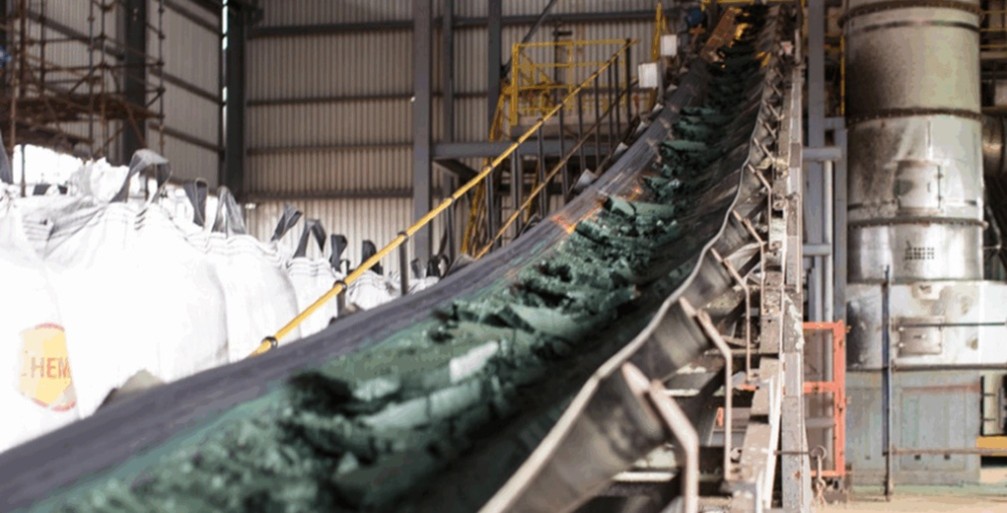
Cobalt processing.
US firm Virtus Minerals has acquired Congolese cobalt and copper producer Chemaf, US Under Secretary of State for Economic Affairs Jacob Helberg said on Tuesday.
Congo has been seeking to develop a minerals partnership with Washington and has drawn up a list of assets, including Chemaf’s mines, to attract US investment into a sector long dominated by Chinese firms.
“US firm Virtus’ acquisition of the Chemaf mines in the DRC is HUGE for America and for the people of the DRC,” Helberg said in a post on X.
Virtus had earlier said it had agreed to acquire Chemaf for about $30 million. Chemaf also has $200 million in unsecured debt and $700 million in secured debt.
The deal had faced opposition from the CEO and chair of state miner Gecamines, prompting Congo to remove them from their positions, Reuters reported last month.
Chemaf is privately owned, and Gecamines has no stake in it. However, the miner owns the lease to Chemaf’s mines, and any bid for control of Chemaf cannot proceed without its approval.
The Wall Street Journal, which first reported on the deal earlier on Tuesday, said Virtus has also committed to raising about $720 million in investment.
Panama moves to unlock copper from First Quantum mine
The Cobre Panama mining complex includes two open pits, a processing facility, two power plants and a port.
Panama is set to authorize the removal and processing of stockpiled ore at First Quantum’s (TSX: FM) shuttered Cobre Panama copper mine, marking a key step in managing the idled operation.
Commerce and Industries Minister Julio Moltó said the government expects to issue a resolution by Tuesday at the latest, allowing the company to extract and export material already mined and stored on site. The document is in its final stage within the ministry and would enable First Quantum to begin shipping the ore out of the country, La Estrella de Panamá reported.
“We are ready to take the next step,” Moltó said. “Between today and tomorrow, we should issue the resolution that will allow the company to begin removing this material so that it can be taken out of the country.”
The move advances Panama’s broader effort to manage roughly 38 million tonnes of ore mined before the operation was halted in 2023, part of a care and maintenance plan launched last year.
The stockpile is expected to yield about 70,000 tonnes of copper, with proceeds from concentrate sales potentially offsetting preservation costs in 2026, depending on regulatory timing.
Processing could begin about three months after approval and take roughly a year to complete, creating about 700 direct jobs on top of the current workforce of 1,600, along with indirect employment in logistics and services.
Top 50 mining companies power through Iran war – up $250 billion in 2026
At the end of the first quarter the MINING.COM TOP 50* ranking of the world’s most valuable miners had a combined market capitalization of $2.41 trillion, up $250 billion so far in 2026.
The market correction for the world’s major miners and the metals that power them, came a full month before the start of the US-Iran war when gold and silver prices cratered after hitting record highs at the end of January. Stocks of precious metals producers and streamers tanked after gold dropped by double digits and silver entered freefall.
Gold has traded sideways since then, hovering above $4,700 an ounce and silver looks safe above $70 an ounce for now, although that’s still down 50% from its gravity defying spike. While gold did not receive the safe harbour investment a hot war in the Middle East would demand, the yellow metal is still showing a healthy 8% gain year to date. Silver is also trading in positive territory for 2026.
Copper is now down a modest 2% since end-2025 after hitting an all- time high of $6.50 per pound, or more than $14,000 the day before the Friday massacre, but at least one commodities trading desk is saying the bellwether metal is “oversupplied and overpriced” even after a $2,000 a tonne climbdown.
Lithium’s resurgence saw Chile’s SQM (NYSE:SQM) and US producer Albemarle (NYSE:ALB) return to the Top 50 in Q4 2025, bringing the number of lithium stocks in the Top 50 back to three (from the peak of six in 2022). The two companies together with China’s Ganfeng Lithium (SZSE:002460) also join the best performers list this quarter.
Among the upper echelons, Barrick Mining (NYSE:B) stands out with a 5% retreat year to date (versus Newmont’s (NYSE:NEM) 11% gain and Agnico Eagle’s 22% rise) as the company tries to unlock value from its portfolio by separately listing its North American gold assets and pursue a growth path in copper (hence the swap of gold for mining in the company name).
Barrick has assembled a new leadership team to run its US and Dominican Republic mines and last week tapped Goldman Sachs to lead the IPO, which by some estimates could value these assets at $60 billion on their own.
All things being equal, it values its risky operations in countries like military coup prone Mali, its Zambian copper assets and its massive Pakistan copper-gold project at only $10 billion at its current market cap. Things aren’t going well at Riko Diq and just last week Barrick warned of “significant increases” to the project’s budget and an extended timeline.
The Bank of France (BdF) says it has pulled the remaining gold held in New York and replaced it with a similar amount of gold bars in its vaults in Paris.
The gold amounted to 129 tonnes — or about 5% of the bank’s total holdings, according to the bank’s press release issued last week.
France, one of the world’s leading gold holders, has been storing some of its bullion with the Federal Reserve Bank of New York since the late 1920s.
However, an operation to repatriate its gold holdings began in the 1960s leading up to the US termination of the Bretton Woods system, which effectively stopped foreign governments from exchanging dollars for gold.
Despite that, France still held a small portion of its gold with the Reserve Bank of New York.
Gold reserve upgrade
Over the past 20 years , the BdF has also been replacing its “older” or “non‑standard” gold holdings — such as those in New York — with bars that meet modern international standards.
Under the recommendation of a 2024 internal audit, the bank went ahead to replace the US-held gold between July 2025 and January 2026. But instead of refining and transporting the gold, it opted to sell the bars and purchase new bullion in Europe.
BdF Governor Francois Villeroy de Galhau said the decision to keep the new bars in Paris is “not politically motivated,” as the higher-standard gold bars it bought were traded on a European market.
Due to rising gold prices, the move helped the bank to generate a capital gain of €13 billion ($15 billion), bringing it to a net profit of €8.1 billion for the 2025 financial year after a net loss of €7.7 billion in 2024.
Cerrado battles Portugal over stalled copper-zinc project
Drillers at the Lagoa Salgada project in southern Portugal.
Cerrado Gold (TSXV: CERT) reported higher annual earnings on Thursday, though attention is shifting towards a legal dispute in Portugal that could determine the future of its Lagoa Salgada copper-zinc project.
The Toronto-based miner, which produced about 50,000 gold-equivalent oz. last year, filed an injunction challenging an unfavourable environmental ruling issued in January by Portugal’s environmental regulator, known as APA. The decision followed concerns over potential impacts on water resources, even as the company maintains the issue hadn’t been raised during earlier stages of the review process. The local court is reviewing the matter.
“We’re very confident in our case, and we feel that there’s been irregularities in process and timing and conclusions that were not regular,” CEO and Chairman Mark Brennan said on a conference call on Thursday. “We’re hopeful that within a period of two months, certainly by the end of the quarter, we will have a resolution that is satisfactory to all parties.”
Shares in Cerrado traded flat at C$1.67 apiece on Thursday afternoon in Toronto, after a 3% dip in the morning, valuing the company at about C$228 million ($164 million).
The dispute highlights a broader test of Portugal’s permitting regime, as Cerrado faces opposition from local authorities who say the project violates planning rules and lacks environmental viability, while the company argues the approval process itself was flawed.
The outcome could shape investor confidence in the country’s mining sector, particularly as Europe seeks to secure domestic supplies of critical minerals from projects such as Lagoa Salgada, which has been designated a Project of National Interest.
Japan PM Takaichi plans Australia visit to discuss rare earths
Japanese Prime Minister Sanae Takaichi is planning a visit to Australia, seeking to discuss supply chains for rare earth elements and cooperation on safe navigation in the Strait of Hormuz, the Nikkei newspaper reported on Friday.
Takaichi’s initiative comes shortly after Tokyo signed a rare earths deal with France, which Japan’s public broadcaster NHK reported on Wednesday.
Japan and Western governments have been aiming to diversify away from the supply chain largely dominated by China, the world’s largest rare earths producer and supplier.
The Japanese and Australian leaders will also discuss the “free and open Indo-Pacific” initiative, the Nikkei report said.
The attempt to lessen dependence on China has allowed Australian miners to secure deals, with Lynas agreeing a potential rare earths deal with South Korea’s LS Eco Energy last week.
The Australian resources minister said on Thursday that France was among the countries that were set to invest in Australian critical mineral projects.