Teck’s undisclosed royalty worth billions on Barrick’s Fourmile could stymie IPO plans
Gold and silver prices plunge as oil shock fuels inflation risks
KoBold Metals targets early-2030s copper output at Zambia project
UK to cut steel import quotas, raise tariffs to protect domestic industry
Sangdong tungsten mine in South Korea returns to production after 30 years
Congo to approve Chemaf sale to US-backed Virtus
Teck’s undisclosed royalty worth billions on Barrick’s Fourmile could stymie IPO plans
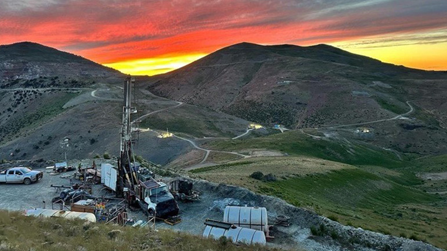
Teck Resources (TSX: TECK.A/TECK.B; NYSE: TECK) holds a royalty on Barrick Mining’s (TSX: ABX; NYSE: B) Fourmile gold project in Nevada that could generate billions of dollars and impact the valuation of Barrick’s planned North American mine spinoff, reports say.
A view of the Fourmile project in Nevada
Teck owns a 10% net legacy profits interest over an area that covers 260 sq. km and includes a “meaningful” overlap with the Fourmile discovery, Scotia Capital mining analyst Orest Wowkodaw wrote Thursday in a note, citing information provided by Teck and Barrick. The royalty climbs to 15% after 6 million oz. of gold are delivered, Wowkodaw said.
The Globe and Mail first reported the story on Wednesday. Barrick and Teck didn’t immediately respond Thursday to e-mails from The Northern Miner seeking comment on the royalty.
“Overall, we view this development as positive for Teck and negative for Barrick,” Wowkodaw said. He values Fourmile at about $15 billion, or 19% of Barrick’s net asset value – assuming that the mine can start operating in 2030 and reach full production in 2034.
Gold and silver prices plunge as oil shock fuels inflation risks
Gold and silver prices plunged on Thursday as the war in the Middle East continues to lift energy prices, fueling inflation concerns and diminishing the chances of a Federal Reserve rate cut.
Spot gold tumbled as much as 6% test the pivotal $4,500-an-ounce level — last seen post the end-of-January crash. The yellow metal has now declined for seven straight sessions, its longest losing streak since 2023, and is over $1,000 off its record high from nearly two months ago.
Silver, meanwhile, fell over 10% to below $66 an ounce, its lowest since late December. The metal is now down by more than 45% from its peak of $121.65 set in January.
Inflation pressure deepens
Soaring crude and gas prices from the ongoing Middle East conflict have become a key driver behind the precious metals’ declines in recent days, as they add inflationary pressures to the global economy. Higher inflation reduces the likelihood of central banks cutting interest rates, making non-yielding assets like bullion less appealing to investors.
A day earlier, the Fed expectedly kept rates untouched, citing uncertainty surrounding the war’s impacts. It also projected just one cut this year, with Chair Jerome Powell saying a reduction would be dependent on slower inflation.
Since the US-Israeli strike on Iran nearly three weeks ago, gold has been largely trading within a narrow range, but this week started to trend lower as the inflationary worries intensified.
Some analysts say the fluctuation has scared off investors. “It’s not a safe haven anymore, it’s a speculative asset,” Patrick Armstrong, chief investment officer of Plurimi Wealth, told Bloomberg.
“With funds continuing to rotate into energy and chemicals, there is little support for metals prices while the conflict continues,” BMO noted.
KoBold Metals targets early-2030s copper output at Zambia project
KoBold Metals, the mining firm backed by US billionaires Jeff Bezos and Bill Gates, has started development of its Mingomba copper project in Zambia, targeting production in the early 2030s, its Africa CEO told Reuters on Wednesday.
Zambia, Africa’s second-largest copper producer after Democratic Republic of Congo, aims to more than triple its copper output to 3 million metric tons by 2031, and projects like Mingomba are central to meeting this goal.
“We’ve started mine development,” KoBold Metals Africa CEO Mfikeyi Makayi said. “We’re now full swing into our permitting process for us to get approvals to start building the mine,” she said, adding that shaft sinking was expected in early 2027.
“With us moving quite fast, it’s to get that build into production early 2030s,” said Makayi.
The company has completed land acquisition for key mine infrastructure, including processing plants, a tailings dam, and administrative facilities, she added.
The project’s investment requirement is estimated at $2.3 billion to $2.5 billion, Makayi said, with the mine expected to produce 300,000 metric tons of copper annually.
On how KoBold will finance the mine, she said: “It’s an interesting project, and many places around the world, most people partner. So yeah, we have different conversations, but right now, it’s still only KoBold and we’re confident we’re okay, we’ve got some runway to carry the project forward at this stage.”
Wider African ambitions
The mine development comes as the United States steps up efforts to loosen China’s grip on metals and minerals crucial in the manufacturing of everything from mobile phones to cars.
KoBold, which uses artificial intelligence to search for copper, cobalt, nickel and lithium, last year secured seven permits to search for lithium and other minerals in the Democratic Republic of Congo.
UK to cut steel import quotas, raise tariffs to protect domestic industry
Britain will lower its tariff-free quota on imported steel and double the tariff on imports exceeding that quota, the government said on Thursday, launching a plan to protect its small but strategically and politically sensitive steel sector.
Steelmakers have struggled to survive in the birthplace of the Industrial Revolution after decades of decline driven by long-term de-industrialization and, more recently, by high energy costs and a global glut of cheap steel.
The government will cut the amount of steel that can be imported without incurring tariffs by 60%. Imports above that new level will face a 50% tariff – twice the previous rate of 25%. The changes will come into force on July 1.
The move brings Britain’s tariff rates into line with recent increases in the United States and proposals by the European Union, against a backdrop of heightened global trade tensions as US President Donald Trump uses trade measures to further his “America First” agenda.
The British government also said that its National Wealth Fund would make up to 2.5 billion pounds ($3.33 billion) available to help finance investment in the sector and that it wanted 50% of steel used in Britain to be produced domestically, up from the current target of 30%.
“Making steel in the UK is vital for national security, critical infrastructure and the wider economy,” Business Secretary Peter Kyle said in a statement.
“With this strategy we are closing the decades-long chapter of destructive de-industrialization and committing instead to strengthening and sustaining Britain as a steel-making nation.”
Unions and industry bodies welcomed the measures.
The sector only accounted for 0.1% of UK economic output in 2024 but supported 37,000 jobs, many in heartlands of the governing Labour Party which grew from a trade union movement deeply rooted in Britain’s industrial heritage.
Sangdong tungsten mine in South Korea returns to production after 30 years
Almonty Industries (NASDAQ: ALM) (TSX: AII) has completed the first phase of commissioning at the Sangdong tungsten mine in South Korea, marking its return to production after more than 30 years.
Phase 1 of the Sangdong mine in Gangwon province is now commissioned and producing, with the processing plant designed to handle approximately 640,000 tonnes of ore annually, yielding roughly 2,300 tonnes of tungsten concentrate per year, the company announced on Monday.
A planned Phase 2 expansion, expected to come online in 2027, is designed to increase processing capacity to approximately 1.2 million tonnes of ore annually, doubling tungsten output to roughly 4,600 tonnes per year, the company added.
Sangdong has an expected mine life exceeding 45 years and an average ore grade of approximately 0.51% tungsten trioxide (WO₃), roughly three times the global average. At full capacity, Sangdong is expected to supply around 40% of the global tungsten demand outside China, Almonty said.
Tungsten is a smaller market, but the industries that depend on it are getting exponentially bigger, and it is the material of choice for a key defense application – what the military calls penetrators – high-density, armour-piercing projectiles. It’s also required in US Department of Defence (now Department of War) contracts.
Tungsten production in the US ceased in 2015. The US had been mining tungsten, but it was no longer commercially viable due to low prices and competition from China, which controls over 80% of global production
The Sangdong mine was historically one of the world’s largest tungsten producers before operations were suspended in the early 1990s following a prolonged downturn in commodity prices. Since acquiring the project in 2015, Almonty has invested more than $100 million to redevelop the site as a modern underground mining operation with a newly constructed processing plant.
The redevelopment includes approximately four kilometers of underground tunnel development, a mineral processing plant equipped with SAG and ball mills supplied by Metso, and advanced operational monitoring systems.
“The completion of Phase 1 at the Sangdong tungsten mine marks the culmination of more than a decade of investment and development,” Almonty CEO Lewis Black said in a news release.
“This is a significant milestone in the effort by the United States and its allies to diversify supply chains for critical minerals away from China, which currently produces approximately 88% of the world’s tungsten supply.”
The Democratic Republic of Congo is reportedly ready to approve the sale of Chemaf to US-based Virtus Minerals, advancing a strategic minerals partnership between Washington and the African nation.
Congo’s mines minister, Louis Watum, notified Virtus last week that the government intends to clear the takeover, according to sources cited by Bloomberg News, marking a key step in a deal involving one of the country’s most contested mining assets.
Chemaf, owner of the Mutoshi copper and cobalt project, put itself up for sale in 2023 after financial strain stalled development of what was planned as one of the world’s largest cobalt mines.
The transaction tests a broader US–Congo minerals agreement signed in December alongside a Washington-brokered peace deal between Congo and Rwanda, as the US seeks to reduce reliance on China for critical minerals. Congo has become central to that strategy given its vast reserves of copper, cobalt, lithium and tantalum, with the Chemaf process emerging as an early signal of how preferential access for US investors will work in practice.
Virtus agreed to acquire Chemaf’s equity for $30 million and plans to invest about $750 million to complete stalled projects, while assuming debts owed to creditors including Trafigura Group, whose $600 million loan in 2022 funded construction at Mutoshi and expansion at the Etoile operation. The company signed the purchase agreement in February with trustees representing roughly 95% of Chemaf’s shares, though Congolese law requires state approval for changes of control over mining permit holders.
Congo has wielded significant influence over the sale through state miner Gecamines, which holds a key permit leased by Chemaf for Mutoshi, after previously blocking a proposed deal with a Chinese state-backed firm.
The acquisition is one of several projects underpinning the US–Congo pact, alongside Orion CMC’s preliminary deal to acquire stakes in Glencore’s (LON: GLEN) Congolese copper-cobalt mines and a proposed railway by Portugal’s Mota Engil SGPS linking the copperbelt to Angola’s Atlantic coast, highlighting a broader push to reshape supply chains for critical metals.