Mideast aluminum makers suffer damage from Iranian attacks
Site visit: EnergyX launches first US direct lithium extraction plant in Texas
Macquarie says copper is oversupplied and overpriced
Ethiopia signs $13.1 billion of energy, mining investment deals
AngloGold confirms economics for 4.9Moz Nevada project, feasibility planned
Barrick delays Reko Diq project amid Middle East concerns
Mideast aluminum makers suffer damage from Iranian attacks
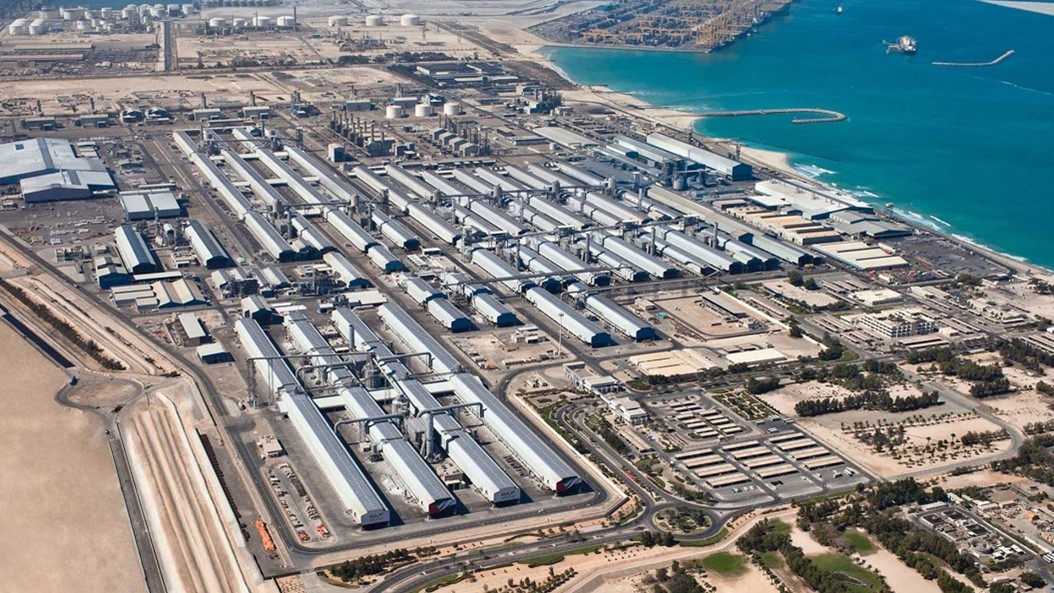
EGA’s Jebel Ali smelter
Two Middle Eastern aluminum producers were hit by Iranian attacks on Saturday, highlighting the challenge to the global economy as the war disrupts vital industries.
The region’s top producer, Emirates Global Aluminium, said it sustained “significant damage” at its site in Abu Dhabi, while Aluminium Bahrain said it was assessing the extent of damage to its facility.
The attacks are another blow to the region’s commodity industry, with producers mostly prevented from exporting by the effective closure of the Strait of Hormuz. In addition to the disruption to shipping, Iranian attacks have damaged key facilities, likely extending the time it will take for operations to return to normal when the war is over.
Aluminum prices, already rising before the conflict, have gained further as traders and buyers focus on the potential for tighter markets and shrinking global inventories. The Middle East accounts for around 9% of global supply and much of that is now blocked inside Hormuz. Higher commodity prices will weigh on global economies, according to Goldman Sachs Group.
EGA is still assessing damage from the attack on its Al Taweelah site located at the Khalifa Port industrial zone in the emirate of Abu Dhabi, the company said in a statement. It confirmed that several employees were injured, but declined to say whether operations at the facility had been suspended.
Site visit: EnergyX launches first US direct lithium extraction plant in Texas
At a packed event in Hooks, Texas, EnergyX this week unveiled a first-of-its-kind lithium production facility — project Lonestar — marking a significant step toward establishing a scalable domestic supply of battery-grade lithium in the United States.
The company’s now operational demonstration plant is capable of producing approximately 250 metric tons per year of lithium carbonate equivalent (LCE).
While modest in output on a global scale, the facility represents a critical validation of EnergyX’s proprietary direct lithium extraction (DLE) technology and refining technologies under real-world, industrial conditions.
EnergyX can now internally produce a core component of its ‘GET-Lit’ lithium separation technology portfolio at an industrial scale.
“Bringing the biggest integrated DLE lithium demonstration plant online in the United States is a foundational milestone for EnergyX and for US domestic lithium production,” EnergyX CEO Teague Egan said.
“This facility not only validates the performance of our technology on an industrial scale under real-world conditions but also establishes EnergyX as the lowest cost producer in the US.”
Macquarie says copper is oversupplied and overpriced
Copper ended Thursday down 1.5% from the previous close and May futures were last worth 5.47 per pound, or little over $12,000 a tonne. Copper has given up more than 16% or $2,400 per tonne from its all-time high struck at the end of January, a day before the start of the Iran war.
In a new analysis from Macquarie Strategy, the bank’s 11 analysts in locations including Geneva, Houston, London, Shanghai and Singapore argue that copper’s extraordinary run since December was less about fundamentals and largely driven by investor flows into base metals. Shanghai futures exchange trading volumes in base metals in January was up 80% over December, for instance.
Macquarie also points out aggregate open interest in copper contracts across New York, London and Shanghai swelled by $9.5 billion across December and January before reversing course, with a $24.6 billion decline through February and March accompanying the price correction.
In Macquarie’s view, the rally has left the market “overpriced, oversupplied and over the pond,” with little evidence of genuine tightness in physical supply.
Visible global inventories have risen sharply, increasing by more than 1 million tonnes since the start of 2025. Stocks on the LME have climbed to six-year highs, while inventories on the COMEX have reached unprecedented levels. The bank also estimates that a further 480,000 tonnes of copper is sitting off-exchange in the United States, drawn in by arbitrage opportunities between CME and LME pricing.
Ethiopia signs $13.1 billion of energy, mining investment deals
Ethiopia has signed $13.1 billion of investment deals spanning renewable energy, manufacturing, real estate, mining and green ammonia, according to the government.
Addis Ababa, Ethiopia
Representatives of the investing companies — from China, Poland, India, Singapore and Kenya — converged in the capital, Addis Ababa, to ink accords at the Invest in Ethiopia conference.
“These are a great success, but they are only a starting point,” said Zeleke Temesgen, head of the Ethiopian Investment Commission. “The real success will be how quickly these investment commitments translate into operational promise on the ground.”
Deals signed:
Ming Yang Smart Energy Group Ltd., a Chinese renewable energy company, intends to invest $10 billion into green ammonia production and the manufacture of electrical equipment.
Global Future Investment Ltd. is exploring manufacturing opportunities in a special economic zone for a total $2 billion.
Liaoning Fangda Group Industrial Co. will invest $500 million in steel and pharmaceutical manufacturing.
Rashmi Group has earmarked $235 million for establishing a mining operation in the country.
Gobez Electric Manufacturing Plc plans to expand its solar-cell production capacity by injecting $150 million.
Sun King will invest $150 million by 2030 in solar equipment manufacturing.
Quantum Everest, a Polish company, will engage in real estate for a total $100 million.
AngloGold confirms economics for 4.9Moz Nevada project, feasibility planned
The Arthur gold project is one of several assets being advanced in southern Nevada. Credit: AngloGold Ashanti
AngloGold Ashanti (NYSE: AU) says a new technical summary for its Arthur project in Nevada has confirmed its potential to become a Tier 1 gold deposit situated within the historic Beatty mining district.
The gold miner announced on Thursday the completion of the project’s pre-feasibility study, incorporating its first-ever gold reserves totalling 4.9 million oz. from two deposits. This could support an initial nine-year mine life with average annual gold production of 500,000 oz.
More than 95% of the mineralization is hosted in oxide material, making it amenable to bulk mining methods and conventional processing, the report highlighted.
Nevada greenfield asset
The Arthur project from a key part of AngloGold’s strategy of establishing a “world-class, long-life” production hub in the US, centered around a portfolio of greenfield assets in Nevada that it has built in recent years. In July, the company expanded its holdings in the gold-rich state with a C$152 million deal for Augusta Gold.
The Beatty district, as the company noted, represents a focal point of that strategy due to its mining heritage and quality of assets. The region has a century-long history of mining, but activities were halted for decades until the 2010s. AngloGold moved early into areas that had seen little contemporary exploration, and in 2018 made the Silicon and Merlin discoveries that make up the Arthur project.
Barrick delays Reko Diq project amid Middle East concerns
The Reko Diq deposit is located in the Balochistan province.
Barrick Mining (TSX: ABX, NYSE: B) says it will slow its development of the Reko Diq deposit in Pakistan’s Balochistan province and extend the project’s review period, citing security concerns in the Middle East.
The decision, first reported by the Financial Times on Thursday, adds further uncertainty to the buildout of what is considered to be one of the world’s largest undeveloped copper-gold projects.
Shares of Barrick edged lower on the news, trading within a narrow range between $37.70 and $38.97 in New York. It has a market capitalization of nearly $67 billion.
The delay follows preliminary findings from a review announced by Barrick last month to examine all aspects of the project, including capital allocation. The review, according to the company, will now be extended for 12 months from July amid recent escalation in security issues caused by the Iran conflict.
Barrick, which has been developing the project in partnership with the governments of Pakistan and Balochistan for years, initially planned for the project to come online in 2028, subject to financing. The cost for Phase 1 of the project alone would be upwards of $5.6 billion.
Once operational, the mine is forecast to generate over $70 billion in free cash flow and $90 billion in operating cash flow over a 37-year lifespan.